Saturday, May 7, 2016

More from our California Indians unit

After reading a selection of legends, students in our class wrote their own, and shared them around smaller campfires.  We also made a class book with all our legends collected together!


Mrs. Rosales also arranged a visit from the Maidu Museum in Roseville, which our generous PTO paid for.  Our presenter showed us real artifacts from local tribes!

All third graders also got a chance to grind acorns!


Wednesday, February 24, 2016

Native American Legends!

Enjoy this sample legend written by one of our very own third graders.  Please note his use of knowledge about the Chumash tribe, the legend structure, the elements of nature, and the way his legend offers an explanation for one of the Chumash traditions.  Well done!  We will collect all the legends and use them for our published class book!
How the Chumash Made Canoes


Once a long time ago, the Chumash didn’t have canoes to sail across the ocean of the southern coast.  The problem was that to spread their population, they had to build on a stranded island.  The Chumash people tried to swim to the stranded island, but they couldn’t swim that far.  The Chumash people wanted to ride the crocodiles to the island but the chief said, “That’s a really bad idea.  We’re not even crocodile riders.”  The chief stared at the crocodiles for a moment and then got an idea of constructing boat,s called canoes.  The chief asked his people to build canoes, big and small.  So the Chumash people tried weaving grass together, but it wasn’t strong.  Then the Chumash had an idea of using rocks but they sank into the water.  Then, the Chumash used wood for the canoes and it worked perfectly.  Now that the Chumash had canoes, they could do many things.  They could spread their population, they could explore other islands, and hopefully not get attacked by the Gabrielino.  The Chumash would now have explorers to explore islands of the southern coast.  And that’s how the Chumash made canoes.

Wednesday, February 17, 2016

Valentines Day!

We had a delightful time passing out Valentines cards, sweets, and treats...


...(and we did have PLENTY of treats...yum!!!)...
Gotta love third graders' Valentines' bags!
I felt so spoiled and loved...thank you very much!!


Trivia!

Since the kids heard I play on a trivia team on Mondays, they've been asking about it every week.  One of my teammates agreed to come do trivia in our class, and we had a BLAST!!
The winning team scored 25/30 (which is much better than my team's average score...)
Listening attentively to Mr. Dan...
...collaborating in teams of 4...
...thinking hard about some of the answers...

Joel even dressed up for the exciting occasion! 
It's not about winning, it's how you play the game...

Snapshots

I don't get pictures of every activity we do during the day, and I even forget some of the "big" things, but every once in awhile I find something I want to share.
Like...

...easy-to-practice multiplication BINGO...
...our MLK bulletin board (it's still up in the office!)...
...a quote off my desktop calendar that we shared and discussed...
...a student's math homework (he told me he was "using algebra")...
...my excitement to meet with all of you for Parent-Teacher conferences...
...some of our class with Olaf...


...art during VAPA...
...student-drawn staff portraits, including Mr. Parker-
-and me!...
...the proud moment of a Star Student...
...using fraction strips during math...

...and a unique way to show 3/4!

STEM Pancake Project

4 groups.  1 skillet. Numerous measuring cups and spoons.  
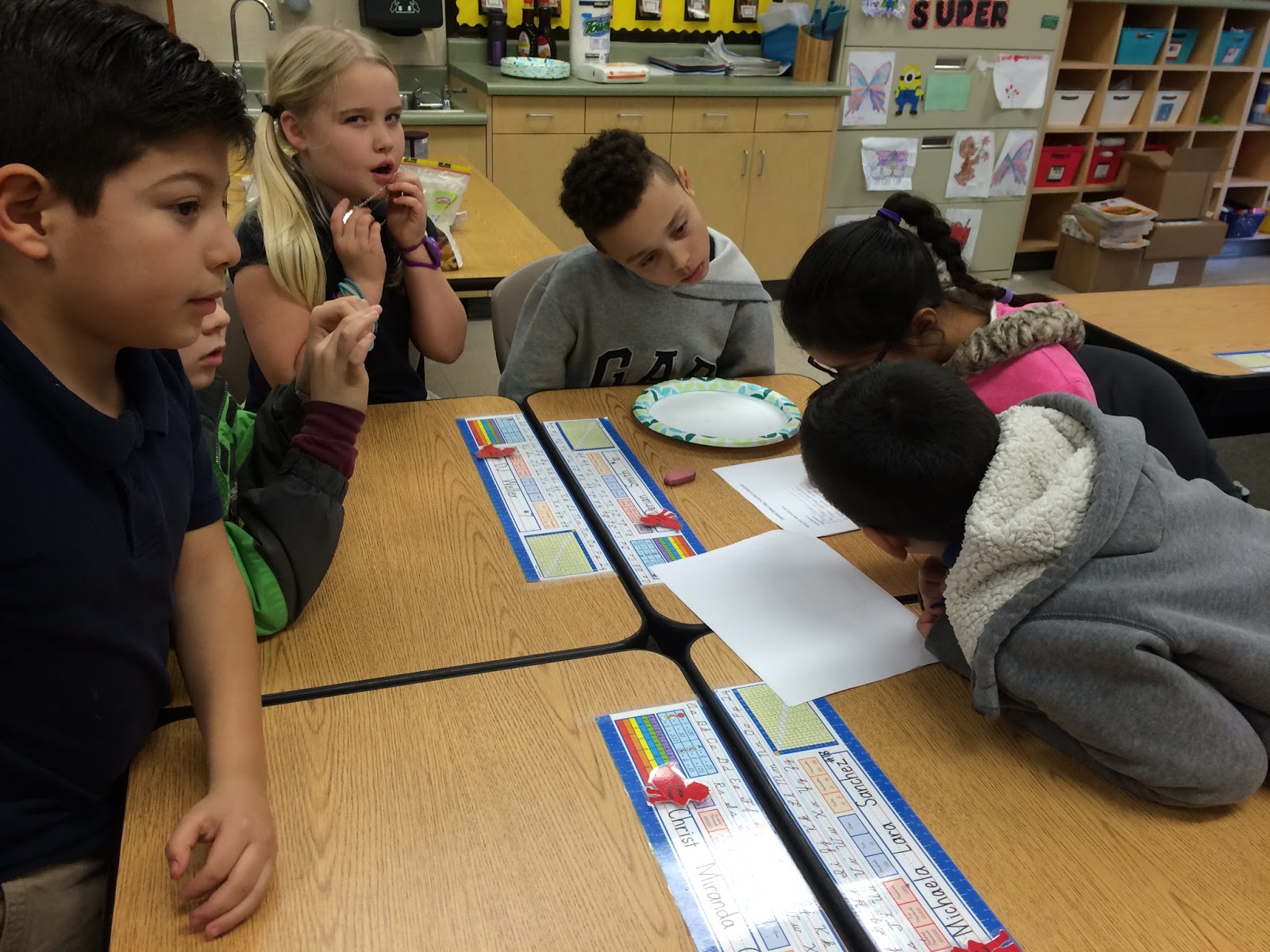
Using the Scientific Method, students were asked to create a better pancake recipe.  Experimentation is easy when you get to taste a delicious finished product!  Not all groups were successful, but it sure was fun to try!  Building these life skills of trying, failing, experimenting, collaborating, etc. were worth it!


Each group had a different approach, but all groups had to communicate their ideas and then come to an agreement about what they would try.

The measuring station was a blast!
After their first attempt, students revised their recipe and tried again!


Of course, when we were all finished with our experiments...we ate!

If only all science was this delicious...

Tuesday, January 12, 2016

Rubrics for Animal Reports

As you work on your animal reports, please keep the following criteria in mind.  Thank you!  The criteria for the animal project/diorama will follow shortly.

Rubric for Animal Report Research and Outlines
Name: __________________

1
(does not meet expectations)
2
(approaching expectations)
3
(meets expectations)
4
(exceeds expectations)
CEL.3.W.R
Research to build and present knowledge


CEL.3.W.7            Conduct Short Research Projects


CEL.3.W.8            Recall/Gather Relevant Information


CCSS.W.3.2.A
Introduce a topic and group related information together


CCSS.W.3.2.B
Develop the topic with facts, definitions, and details


CCSS.W.3.2.D
Provide a concluding statement


Total Points: _________________ - _______ (1 point for every day late) = ____________


Animal Report Writing Rubric
Name: ____________________________________

1
Not meeting standard
2
Approaching standard
3
At grade level standard
4
Exceeding standard
W.3.2.A
Introduce a topic and group related information together; include illustrations when useful


W.3.2.B
Develop the topic with facts, definitions, and details.


W.3.2.C
Use linking words and phrases (e.g., also, another, and, more, but)


W.3.2.D
Provide a concluding statement or section


W.3.4
With help from adults, produce writing with appropriate development and organization


W.3.5
With help from peers and adults, plan, revise, and edit writing


W.3.6
With help, publish writing on the computer


Animal Report Rubric: Speech
Name: _____________________


1
Not meeting standard
2
Approaching standard
3
At grade level standard
4
Exceeding standard
SL.3.1.C
Ask relevant questions to check understanding, stay on topic, and respond to others


SL.3.1.B
Follow agreed-upon rules for discussions


SL.3.3
Ask and answer questions about information from a speaker


SL.3.4
Report on a topic or text with appropriate facts and details, speaking clearly at an understandable pace.


SL.3.6
Answer peers’ questions with detail and in complete sentences.